



from valley to valley, camping
in the Hautes-Pyrénées
The Hautes-Pyrénées region
A single département, seven valleys, and as many ways to experience the mountains. From the sanctuaries of Lourdes to the glacial cirques of Gavarnie, from the laces of the Tourmalet to the lakes of Néouvielle, the Hautes-Pyrénées is a mosaic of territories where each valley cultivates its own character. Thermal baths, mountain passes, stone villages, high altitude panoramas: here, diversity is a promise. And to enjoy it to the full, there’s nothing like camping in the Hautes-Pyrénées, close to the valley that suits you best.
each valley has
its campsites

between lake
and summits
Louron Valley – Peyragudes
Here you are in a valley that has preserved its mountain soul, the Louron Valley, where authenticity can still be read in every stone of its centuries-old villages. Fifteen typical communes , awarded the “Pays d’Art et d’Histoire” label in January 2008, surround the lake at Génos-Loudenvielle, the jewel in the crown of this département 65 region, which cultivates a unique art de vivre. When you stay at a campsite in the Hautes-Pyrénées, you’ll be amazed by what you can discover!
The lake shimmers beneath the surrounding peaks and unfolds its natural playground. Contemplative fishing, pedal boating, canoeing… The riverbanks invite you to relax, while the Ludéo aqualudic complex offers pools and slides for families. The Ludic Park completes the offer with inflatable structures and a suspended course in the trees.
Our campsites in the Louron-Peyragudes valley:

Camping La Vacance Pène Blanche (Loudenvielle)
Campsite Le Lustou (Adervielle-Pouchergues)
Camping Le Refuge international (Arreau)
Camping Municipal d’Arreau (Arreau)
Camping Municipal Le Hourgade (Vielle-Louron)


Balnéa reigns supreme in the art of mountain balneotherapy. Here, baths from around the world come in a range of strikingly themed universes: a Roman lagoon with hydromassage jets and heated benches, an Amerindian space where bubble beds and geysers watch over ancestral totem poles, Japanese Onsen basins offering warm waters between 33° and 40° facing the Pyrenees, with a Zen garden and Tai Chi initiations, personalized Tibetan treatments with sesame oil and singing bowls…
The mountains offer something for everyone: a peaceful tour of the Lac de Génos-Loudenvielle, an interpretation trail in the upper valley, the classified Clarabide gorges for contemplative walkers, the Lac de Caillaouas and Pic de Hourgade for experienced hikers. Exceptional aerological conditions make this valley a prime spot for paragliding and hang-gliding. Mountain biking, DévalBike, cani rando and via ferrata are also available.
The Romanesque heritage is testimony to the region’s rich history. The exceptional concentration of churches in this part of département 65 reveals a remarkable architectural past.
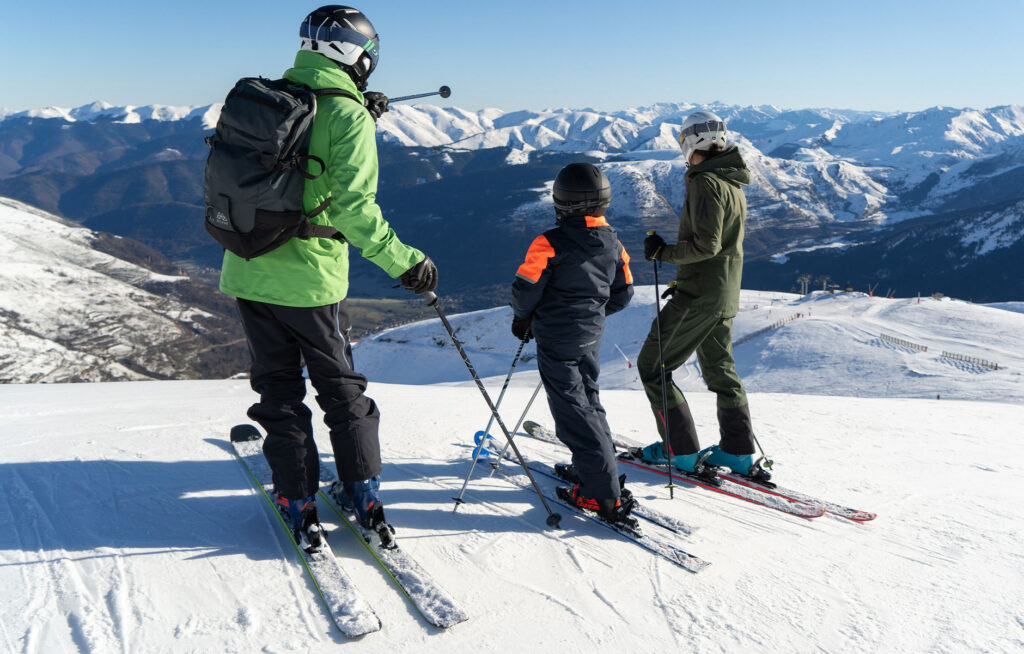
Peyragudes has dominated winters since 1988, born from the union of Peyresourde and Les Agudes. The resort spans 1,500 hectares between 1,600 and 2,400 metres above sea level, with 51 runs on two slopes and 18 ski lifts. A striking geographical feature: it straddles the Louron Valley in the Hautes-Pyrénées and the Larboust Valley in Haute-Garonne. The Skyvall gondola now links Loudenvielle to Peyresourde at the foot of the slopes. This four-season connection frees skiers from winter road conditions and, in summer, opens up its playground to hikers, mountain bikers, paragliders and walkers. Awarded the Famille + label since 2016-2017 and a member of the N’PY group bringing together 8 Pyrenean resorts, Peyragudes is complemented by Val Louron and its friendly, family atmosphere.


Vallée d’Aure – Saint-Lary – Néouvielle
The Aure valley is an exceptional territory in the 65 department of France, awarded the Pays d’art et d’histoire label in 2008. This label, awarded by the French Ministry of Culture and Communication, recognizes areas that know how to animate and promote their heritage. Saint-Lary-Soulan now reigns supreme, as the former capital of Arreau has given way to this must-see resort.
A priceless natural treasure, the Néouvielle National Nature Reserve is located in the communes of Aragnouet, Saint-Lary-Soulan and Vielle-Aure. Created in 1936 by Professors Bressou and Chouard, it was one of the first reserves in France. As early as 1922, the scientific interest of the site had become apparent with the foundation of a biology laboratory near Lac d’Orédon. In 1968, the State took over the management of the site by ministerial decree, entrusting it to the Parc national des Pyrénées.
Our campsites in the Aure valley – Saint-Lary – Néouvielle :
Campsite Aire Naturelle DE CADEAC (Cadeac)
Campsite ARTIGUETTE (Vignec)
Camping caravaneige LE LUSTOU (Vielle-Aure)
Camping D’AUTUN (Saint-Lary-Soulan)
Campsite LA MOUSQUERE (Bourisp)
Camping Le Lavedan (Guchen)
Camping LE RIOUMAJOU (Bourisp)
Campsite LE RUISSEAU (Gouaux)
Between 1,800 and 3,091 meters above sea level, the 2,313-hectare reserve lies to the northeast of the Pic de Néouvielle. Quaternary glaciers sculpted this granite landscape: flat-bottomed cirques separated by “caterpillar” ridges, hollowed lakes, deposited moraines… The result is a unique aquatic universe. Seventy lakes dot the region: large ones like Aubert and Aumar, dam lakes, and the Laquettes forming a string of small lakes.
The reserve’s exceptional microclimate, warmer and drier thanks to its southern exposure and the shelter of a high ridge running from Pic de la Munia to Arbizon, pushes back the limits of vegetation. Hooked pine beats all records here, climbing to an altitude of 2,800 metres.
Biodiversity flourishes here: 1,250 vascular plants, including the extremely rare Subulaire aquatique and the Androsace des Pyrénées, 180 animal species, including the Alyte, whose larvae can live for ten years, the Desman des Pyrénées, the Capercaillie and the Isard. The ubiquitous aquatic environments reveal 571 species of algae.
Saint-Lary’s ski area has been spread over three distinct sectors since 1957: Pla d’Adet, Espiaube and Vallon du Portet. Altitudes range from 1,700 to 2,515 meters, with the village linked to the slopes by cable car and gondola. A major geographical asset: the Bielsa tunnel provides direct access to Spain, revealing the riches of the Aragonese Sobrarbe and its geological heritage.
The built heritage of département 65 is well worth exploring. Romanesque churches and chapels are home to sculpted spandrels, gilded altarpieces and multicolored frescoes. On the Col d’Azet road between Sailhan and Estensan, the Moulin de la Mousquère, a medieval vestige, bears witness to the hydraulic ingenuity of yesteryear.
From your campsite in the Aure valley, these natural and cultural treasures are just a few minutes away, for a holiday that combines adventure and rejuvenation.


a collar
mythical

Tourmalet – Pic du Midi
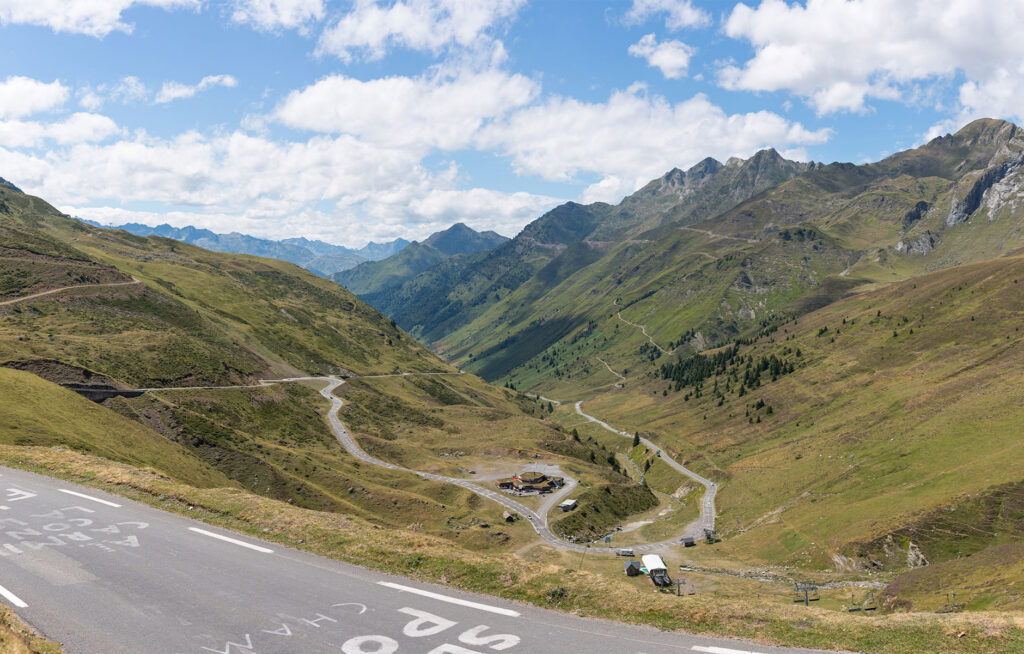
At an altitude of 2115 metres, the Col du Tourmalet is a mythical link between two worlds. Dominated to the north by the Pic du Midi de Bigorre and to the south by the Pic d’Espade, this passage between the Adour and Gave de Pau valleys bears a name that resonates in the world of cycling. Nearly 80 times, the Tour de France has taken these legendary laces, an absolute record that makes the Tourmalet the world capital of cycling. Fausto Coppi, Fédérico Bahamontès, Eddy Merckx, Lucien Van Impe… All the giants have engraved their legend on the asphalt and in the collective memory.
Nineteen kilometers from Luz-Saint-Sauveur, average gradient 7.4%. The eastern slope from Sainte-Marie-de-Campan stretches for 17.2 kilometers at an average gradient of 7.37%. At the summit, the iron silhouette of the Géant du Tourmalet stands as a monumental tribute to Octave Lapize, the first racer to cross the pass in the lead on July 21, 1910. The bronze bust of Jacques Goddet, director of the Tour de France for fifty years, watches over this emblematic sculpture.
The pass unites the resorts of La Mongie and Barèges into a single territory: the Grand Tourmalet, the largest ski area in the French Pyrenees. One hundred kilometers of slopes stretch from 1400 to 2500 meters above sea level. Since 1873, men have been scrutinizing the stars at thePic du MidiObservatory in La Mongie. Perched at 2877 metres, this pioneering site remains the oldest high-mountain astronomical observatory in the world. The construction of the meteorological observatory in 1882 marked the start of an exceptional scientific adventure. Scholars, scientists and porters transported the equipment by mule and man for two years, between 1907 and 1908.
Our campsites in the Tourmalet valley – Pic du Midi :
Campsite BELLEVUE DES PALOMIERES (Bagnères-de-Bigorre)
Campsite L’Adour (Gerde)
Campsite L’ARRIOU (Beaudéan)
Camping l’OREE DES MONTS (Campan)
Campsite LA POMMERAIE (Gerde)
Campsite LE MESNIL (Bagnères-de-Bigorre)
Campsite LE MONLOO (Bagnères-de-Bigorre)
Campsite LES FRENES (Campan)
Campsite LES FRUITIERS (Bagnères-de-Bigorre)
CAMPING MUNICIPAL D’ARTIGUES (Campan)
CAMPING VENT DES CIMES (Bagnères-de-Bigorre)
LES 4 VEZIAUX (Campan)
the roof
of the Pyrenees
Since 1981, the Bernard Lyot telescope has stood watch, the first national astronomical sentinel dedicated to the study of stellar magnetism. The site helped NASA map the Moon in 1969. Today, theObservatoire Midi-Pyrénées pursues research in three fields: astrophysics, atmosphere and geoscience. Six astronomical domes house the instruments, while twenty staff provide technical and logistical support.
The cable car from La Mongie lifts the public up to this starship in fifteen minutes. A thousand meters of vertical drop, maximum overflight of 320 meters. The panoramic terraces embrace 300 kilometers of Pyrenean mountain range. The Ponton dans le Ciel, a 12-metre metal footbridge suspended above the void, offers vertiginous sensations.
The Experiments area unveils the historical development of the observatory with Histopad tablets, reconstructions and fun experiments on the Sun, cosmic rays and meteorites. Under the Baillaud dome, the planetarium is the highest in Europe. The purity of the air and the exceptional quality of the sky have earned the Pic du Midi its place among Occitanie’s two International Starry Sky Reserves.
telescope Bernard Lyot

Midi-Pyrénées Observatory

cable car

Pontoon in the Sky

HERE, TIME
at a different pace
Luz – Toy Country
Fiercely independent, the Pays Toy region of the 65 department has a character that centuries have forged over the course of its luminous valleys. “A Toy fears only God, thunder and avalanches”: this saying sums up the soul of this mountain territory, where the Gascon term “Toy”, meaning “small”, was used to describe the inhabitants of these high valleys. 15 communes in the valleys of Luz, Barèges and Gavarnie make up this landlocked region of the central Pyrenees, where harsh winters have carved out a unique mountain culture.
Our campsites in the Luz valley – Pays Toy :
LA GRANGE BIGOURDANE Nature Reserve (Esquièze-Sère)
CAMPING AIR HOTEL PYRENEE (Luz-Saint-Sauveur)
Campsite Happy Pyrénées (Saligos)
Campsite INTERNATIONAL (Luz-Saint-Sauveur)
Campsite LA RIBERE (Barèges)
Camping LE BASTAN (Esterre)
Camping LE BERGONS (Esterre)
Campsite LE HOUNTA (Luz-Saint-Sauveur)
Campsite Les Cascades (Luz-Saint-Sauveur)
Camping PYRÉNÉVASION (Sazos)
Camping SAINT BAZERQUE (Luz-Saint-Sauveur)
Campsite SO DE PROUS (Saligos)
Campsite TOY (Luz-Saint-Sauveur)
LA GRANGE BIGOURDANE (Luz-Saint-Sauveur)


Luz-Saint-Sauveur, capital of the Pays Toy region at an altitude of 677 meters, unfurls its ancient streets around the fortified church of Saint-André. This church, known as the Church of the Knights Templar, owes its fortification to the Hospitallers of St. John of Jerusalem who, in the 14th century, protected it from Aragonese plunderers crossing the mountains. The Hospitallers welcomed pilgrims travelling the Pyrenean routes to Santiago de Compostela.
Victor Hugo sketched this building during his stays in the Pyrenees and celebrated the town: “Charming old town, delightfully situated in a deep triangular valley. Napoleon III profoundly transformed Luz-Saint-Sauveur when he came to take the waters with Empress Eugénie in 1859. At the time, Saint-Sauveur was isolated by a rock face overlooking the river.
To open up the road to Gavarnie and the mountain cirques, the emperor had the Pont Napoléon built, an architectural feat of a single arch hemmed in between the rock faces, built in just one year. Today, this bridge welcomes bungee jumpers.
The Thermes de Luz-Saint-Sauveur, located on a balcony overlooking the Gave de Pau gorges, offer treatments for phlebology, respiratory tract and gynecology.
Thermal water gushes out naturally at 33°, a temperature particularly suited to chronic ENT disorders and the treatment of venous and lymphatic insufficiencies. The Luzéa center combines neoclassical architecture with contemporary facilities: pools, hammam, bubble baths, massages…
Barèges, perched at an altitude of 1250 metres, first came into prominence with the Petit Duc du Maine in 1675. Despite the devastating avalanches of the 20th century, the village, along with La Mongie, forms the Grand Tourmalet, the largest ski area in the Pyrenees. Luz-Saint-Sauveur is also a cycling destination of excellence: climbers set off from kilometer zero in the heart of the village to challenge the Col du Tourmalet and the legendary ascent of Luz Ardiden.
The cultural heritage of the Pays Toy lives on in the polyphonic songs of the Pyrenees.
Gavarnie Valley
At the bottom of a narrow valley in department 65, thelimestone amphitheater of Gavarnie rises like a natural cathedral carved out of the rock. This geological formation of glacial origin unfurls its semi-circular majesty: 1,300 metres high at its center, rising to 1,500 metres at its highest point under the Pic du Marboré, at 3,248 metres above sea level. Over a circumference of 6.5 kilometers at its base, a natural boundary between France and Spain, the cirque is tiered into three successive tiers of equal height.
Our campsites in the Gavarnie valley :
Aire Naturelle Les Tilleuls (Gèdre)
Camping LE MOUSCA (Gèdre)
Camping LE PAIN DE SUCRE (Gavarnie)
INSOLITO 65 (Gavarnie-Gèdre)
The Grande Cascade springs from the heart of this stone amphitheatre. An absolute record: 422 metres high, it is the highest waterfall in mainland France and one of the largest in Europe. The Gave de Gavarnie, born just a few hundred metres from its source in a foothill of the Marboré, rushes down this impressive wall in two jumps, the main one overcoming a 281-metre difference in height. The water vaporizes into a plume of spray, the height creating a current of cold air that maintains a névé and its summer snow bridge. Flow varies from one to three times its capacity: from 6 cubic metres per second at low water to 200 cubic metres per second during floods.
Gavarnie, the highest village in département 65 with fewer than 150 inhabitants, nestles slightly downstream of the junction between the bottom of the cirque and the Pouey Aspé valley. Lourdes is only 50 km to the north as the crow flies. Access to the waterfall is via the mule track to the Hôtel du Cirque de Gavarnie, built on the edge of the scree, and then the track leading to the foot of the waterfall. The tradition lives on: a ride on donkey or horseback.
The three glacial cirques of Gavarnie, Estaubé and Troumouse make up the Franco-Spanish Pyrenees-Mont Perdu site, listed as a UNESCO World Heritage Site in 1997. This exceptional mountain landscape radiates from both sides of the border, centered on the summit of Mont Perdu, a limestone massif culminating at 3355 meters. Villages, farms, fields and high pastures bear witness to an agricultural way of life once widespread in the mountainous regions of Europe.
Gavarnie attracts some 800,000 visitors a year, concentrated in the summer months. Millaris, the Maison des Cirques, retraces the UNESCO adventure and reveals the sublime landscapes, pastoral traditions and importance of water.
The valley’s open-air hotels offer a privileged base from which to explore this UNESCO site, from hikes at the foot of the cirques to starlit nights in the mountains.


thermal baths
to the top


Cauterets – Pont d’Espagne
An exceptional spa resort in the 65 department, Cauterets has been combining beneficial sulfurous waters and unspoilt mountain splendor for centuries. Thermes de Cauterets, Bains du Rocher… This tradition of well-being flourishes in the heart of the Pyrenees National Park, and finds its most spectacular expression 7 kilometers from the center, where the Route des Cascades leads to the Pont d’Espagne.
Our campsites in the Cauterets valley – Pont d’Espagne :
Campsite LA PRAIRIE (Cauterets)
Campsite Le Cabaliros (Cauterets)
Campsite LE GR 10 (Cauterets)
Campsite LE PEGUERE (Cauterets)
Campsite LE VIGNEMALE (Cauterets)
Campsite LES GLERES (Cauterets)
Grand Site Occitanie, the Pont d’Espagne is a breathtaking sight. The ancient mule track once linked France and Spain, giving the site its name. The present-day bridge, a stone structure built in 1886, spans the confluence of the Gave de Marcadau and the Gave de Gaube at an altitude of 1,500 metres. The water rushes and bubbles through this steep-sided valley, crashing with spray and perpetual tumult.
A powerful spring with melting snow, a cool summer welcome for hikers, flamboyant autumn colors, a winter coat of snow and ice… The waterfall changes with the seasons. Victor Hugo, who loved these places, wrote in 1843: “Ah! tu veux des torrents, Parisien! You want gaves, cascades, chasms, precipices, emotions! Well, here they are!
Several paths lead to the site. Car to the Puntas parking lot for 8 euros a day, included in the regular lift pass , or the Chemin des Cascades from La Raillère for the more athletic: a two-hour hike through the undergrowth, punctuated by six magnificent waterfalls.
a road,
six cascades
The Hôtellerie du Pont d’Espagne, a large granite building dating from 1933, has a sunny terrace overlooking the tumultuous Gaves river.
The Gaube chairlift operates from May 8 to September 29. Twelve-minute ascent, then a fifteen-minute walk to Lac de Gaube. Alternatively, take the GR10, a one-and-a-half-hour undergrowth trail winding above the right bank of the Gave.
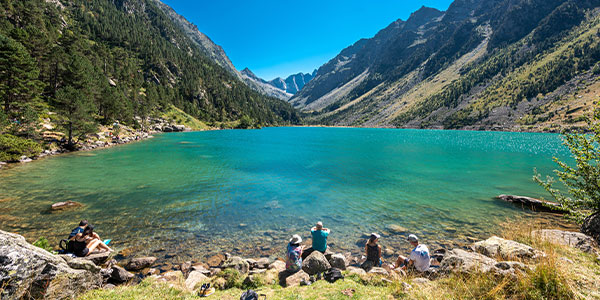
Lac de Gaube lies at an altitude of 1,725 m, a vast glacial expanse measuring 1,500 m by 300 m. Its transparent turquoise waters reflect the surrounding massifs, with the Pic du Vignemale , the highest peak in the French Pyrenees at 3,298 m, as a backdrop. The Hostellerie du Lac de Gaube, open only in summer, offers a stopover in the midst of this grandiose landscape. Experienced hikers continue to the Oulettes de Gaube refuge at the foot of the Vignemale, a three-hour round trip from the lake.
The Marcadau valley offers another easy itinerary, with several gaves crossed by wooden bridges. Winter transforms the site into a Nordic paradise: 36 kilometers of cross-country ski trails, 6 kilometers of snowshoe trails in the Marcadau valley, 3 low-difficulty alpine trails on the Gaube slopes, espaceluge near the Chalet du Clot.
The campsites in and around Cauterets let you experience this exceptional site to the full, from the village thermal baths to the summits of the Pont d’Espagne.
Gaube lake
Pic du Vignemale

refuge des Oulettes dr gaube

Marcadau Valley


well-being
au naturel
Argelès-Gazost – Val d’Azun
As the canton’s administrative centre, Argelès-Gazost enjoys a prime location, making it an ideal base for those wishing to take advantage of the wide range of Pyrenean sites on the one hand, and the area’s thermal and architectural heritage on the other. History has shaped this spa town into two distinct faces: the upper town with its shopping streets watched over by the Tour de Vieuzac, the Tour Mendaigne and the Château d’Ourout from the 15th and 16th centuries, and the lower part born of late-19th-century spa tourism.
The arrival of the railroad seduced curists with its mild climate and gave birth to Argelès-Gazost with the acquisition of the Gazost sulfur springs. Today, the Thermes perpetuate this tradition of well-being with their respiratory and phlebology cures.
Le Jardin des Bains combines brick architecture and gave pebbles, the emerald forest waterfall, hammams, water gardens and soothing treatments. The large English-style spa park unfurls its charms in front of the establishment, surrounded by eclectic-style villas and hotels that give the resort its identity.


Our campsites in the Argelès / Val d’Azun valley:
AIRE NATURELLE BELLEVUE (Ayzac-Ost)
Aire Naturelle La Ferme du Plantier (Ouzous)
Airotel Camping LA CHATAIGNERAIE (Agos-Vidalos)
CABANE PERCHEES DES PYRENES (Argelès-Gazost)
Campsite AZUN NATURE (None)
Campsite Cap Pyrénées (None)
Camping DE LA TOUR (Agos-Vidalos)
Camping Deth Potz (Boô-Silhen)
Campsite DU LAC (Arcizans-Avant)
Campsite L’EDELWEISS (Arcizans-Dessus)
Campsite L’IDEAL (Arras-en-Lavedan)
Campsite LA BERGERIE (Ayzac-Ost)
Campsite LA PRAIRIE (Lau-Balagnas)
Campsite LAC D’ESTAING (Estaing)
Campsite LARBEY (Pierrefitte-Nestalas)
Campsite LE BOSQUET (Bun)
Campsite LE GERRIT (Arrens-Marsous)
Camping le HAUTACAM (Préchac)
CAMPING LE MOULIAN (Arrens-Marsous)
Campsite LE RURAL (Agos-Vidalos)
Campsite LE VISCOS (Beaucens)
Campsite LES CHATAIGNIERS (Arcizans-Avant)
Campsite LES FRENES (Lau-Balagnas)
Campsite LES TROIS VALLEES (Argelès-Gazost)
Campsite Mialanne (Arrens-Marsous)
Campsite PYRENEES NATURA (Estaing)
Campsite SOLEIL DU PIBESTE (Agos-Vidalos)
Espace PYRENEES LOISIRS (Lau-Balagnas)
YELLOH! VILLAGE – LE LAVEDAN (Lau-Balagnas)


Contemporary heritage is worth exploring: the 1955 Lycée-Collège, listed as a historic monument in 2008, is home to mosaics by Singier, Hadju’s intaglio sculptures on the gymnasium pillars, the blue foyer with its marouflaged canvas by Manessier and Charlotte Perriand’s chest of drawers.
To the west, the Val d’Azun, a wide, sunny valley, offers an unspoilt mid-mountain environment dotted with a dozen villages with slate roofs and stone walls. The Station Sport Nature offers a network of 100 kilometers of marked trails between the Col du Soulor in Arrens-Marsous and the Col de Couraduque in Aucun for all outdoor activities, from snow to dirt.
In winter, discover the Nordic area with its 12 cross-country ski trails, 4 snowshoe trails and the Nordic Park at the Col de Couraduque, equipped with two treadmills. Cross-country skiing and snowshoeing schools for beginners, and a laser shooting range for biathletes. Unusual outings spice up the experience: barbecue hikes around an open fire, nightly tartiflette evenings at the refuge, winter wildlife observation with the trapper hike.
The rest of the year, hikers, trail runners and mountain bikers take to the trails. During the vacations, electric scooters and a 300-metre zip line on the Col du Soulor bring the area to life. The Haugarou refuge offers a friendly stopover in the heart of the slopes.
The Parc Animalier des Pyrénées allows you to observe marmots, otters, isards and bears in their mountain setting. The Gave de Pau runs through the valley, offering rafting, hydrospeed and canoeing. Argelès-Gazost’s central location in the 65 département provides easy access to Lourdes, the Pyrenees National Park, the Gavarnie cirque and the Pic du Midi.
Lourdes and the surrounding area
Since 1858, this town in the 65 department of France has had a reputation far beyond the French borders. Lourdes welcomes millions of pilgrims from all over the world, following in the footsteps of Bernadette Soubirous. This young woman from Lourdes saw the Virgin Mary appear to her eighteen times in the grotto of Massabielle, apparitions recognized by the Catholic Church in 1862. The Notre-Dame de Lourdes Sanctuary gradually grew up around this holy site, and today covers 52 hectares. In 2023, the shrine welcomed 3.1 million visitors, making it one of the world’s top four Catholic pilgrimage destinations.
Our campsites in the Lourdes valley :
Camping D’ARROUACH Lourdes (Lourdes)
Campsite L’ARRAYADE (Ger)
Campsite LA FORÊT LOURDES (Lourdes)
Campsite LE LOUP (Lourdes)
Camping LE VIEUX BERGER (Lourdes)
Campsite PLEIN SOLEIL (Lourdes)
The Grotte de Massabielle beats at the heart of the sanctuary. This limestone cavity is 3.80 metres high, 9.50 metres deep and 9.85 metres wide. Pilgrims follow one another in silent procession to touch the rock, contemplate the spring water and meditate. On average, 20,000 pilgrims pass the grotto every day. The spring discovered by Bernadette naturally gushes out near the grotto, credited with miraculous powers. Of the thousands of files submitted to the Sanctuary’s Medical Office, 70 cures have been recognized as miraculous after multiple checks over several years.
Twenty-two places of worship make up the estate. Three major basilicas welcome the faithful: the Basilique de l’Immaculée-Conception dominates the rock, its choir aligned with that of the Grotto; the Basilique Notre-Dame du Rosaire features 15 chapels lined with mosaics illustrating the mysteries of the Rosary; and the underground Basilique Saint-Pie-X can accommodate up to 25,000 people. The church of Sainte-Bernadette stands opposite the Grotto on the right bank of the Gave de Pau.
The Château Fort, perched on its rocky peak, has watched over the town since the Middle Ages. Since 1921, this listed fortress has been home to the Musée Pyrénéen, founded by Louis and Margalide Le Bondidier. The collections retrace daily life in the French and Spanish Pyrenees from the 18th to the early 20th centuries. The panorama from the ramparts embraces the town, the sanctuary and the Pyrenean mountain range.
The Pic du Jer, recognizable by its summit cross, offers a 360° view of Lourdes and the surrounding peaks. The century-old funicular lifts visitors to an altitude of 1,000 metres in just a few minutes. Lac de Lourdes, 3 kilometers from the center, offers swimming, water sports and hiking in this part of the 65 department.


a capital
character


Adour Valley – Tarbes
Capital of the Bigorre region, Tarbes reveals a different face of the Hautes-Pyrénées! This city knows how to take the time to live, with breathtaking views of the Pyrenees from its palm-lined streets. Between the Atlantic and the Mediterranean, this urban area shines with its cultural wealth, equestrian heritage and remarkable green spaces.
Our campsite in the Adour valley – Tarbes :
Campsite LA BERGERIE (Lanne)
The Adour River shapes the identity of the commune. This 308.8 km-long river is born in the Campan valley in Haute-Bigorre from the union of three torrents: the Adour de Payolle, the Adour du Tourmalet and the Adour de Lesponne. After flowing through 118 communes, it empties into the Bay of Biscay at Anglet. The Adour valley is a Natura 2000 site covering an area of 2,694 ha, where terrestrial and aquatic habitats are home to a remarkable variety of flora and fauna, including otters and the European Cistude.
The Jardin Massey, a listed site, is home to the Musée des Hussards, with collections that are unique in the world. Natural urban heritage and typical architecture reveal the richness of Pyrenean marble. The Haras de Tarbes perpetuates a centuries-old equestrian tradition. Founded by Napoleon I, it remains the cradle of the Anglo-Arab breed and revives the equestrian epic of the Bigorre region.
Culture and tradition set the pace in the town all year round: Les Petits As World Tennis Tournament, Tarba en Canta Polyphony Festival , Equestria Festival devoted to the magic of horses and the arts, Tarbes en Tango, International Argentine Tango Festival… Authentic markets with a South-West accent offer local specialities in one of the largest farmers’ markets in the South-West.
The Val d’Adour is enriched by a remarkable architectural heritage: bastides, castelnaux, castles, towers, keeps, abbeys and churches bear witness to an ancient human presence. Water, an omnipresent element, is enhanced by wells, fountains, bridges, wash-houses, mills and canals. Strategically located, Tarbes is within easy reach of all the major sites in the 65 department.
Here you can discover another facet of the Hautes-Pyrénées, where the art of urban living blossoms right up against the peaks!
a land
authenticity
The hillsides – Neste – Baronnies – Barousse
On the foothills of department 65, another side of the Hautes-Pyrénées is revealed between wild forests and typical villages. Rolling hillsides, the Lannemezan plateau, the secret valleys of Barousse, Neste and Baronnies…
This bucolic region is a paradise for hikers, with gentle mountains, hills and valleys to discover along contemplative paths leading up to Signal du Bassia, a viewpoint overlooking the Pyrenees. The Grande Traversée des Pyrénées (GR10) and the Chemin de la Vallée d’Aure ( GR105) are ideal for long-distance hiking.
Our campsites in the Côteaux valley – Neste – Baronnies and Barousse :
Camping D’ESPLANTATS (Sarrancolin)
Campsite LA BOURIE (Hèches)
Campsite LA PLENITUDE (Capvern-les-Bains)
Campsite LE RURAL CAP DES ARRIBAS (Tibiran-Jaunac)
Campsite LES CRAOUES (Capvern)
Campsite DOMAINE DE L’EGLANTIERE (Castelnau-Magnoac)
The Pyrenean Baronnies cultivate a diversity of landscapes: gentle hills where sheep graze, ridges rising to 2000 meters, generous nature dotted with beech, fir, chestnut and boxwood trees. This land of livestock and crafts reveals its geological treasures at the Esparros chasm, an underground crystal garden famous for its unique aragonites, and at the Espace Préhistorique de Labastide, which bears witness to millennia of occupation. The Gourgue d’Asque, a small Pyrenean Amazon with lush boxwood and moss forests, offers a striking contrast between open meadows and deep undergrowth.
The region’s built heritage includes the 12th-century Cistercian abbey of l’Escaladieu and the Château de Mauvezin, a medieval fortress restored by Gaston Fébus. Tournay, capital of the Baronnies and an ancient 14th-century bastide, was the birthplace of Francis Jammes in 1868. Capvern-les-Bains offers L’EdenVik, a balneotherapy center in the spirit of the Viking gods. The Barousse valley, nestled between the Hautes-Pyrénées and Haute-Garonne, perpetuates ancestral traditions.
It celebrates the transhumance at the beginning of June and revives the tradition of brandons, listed as a UNESCO intangible heritage site in 2015. Port de Balès rises to an altitude of 1755 meters. Mauléon-Barousse is home to the Maison des Sources, dedicated to the heritage of this area of department 65, where rural authenticity remains intact.
The hillsides / ©A.BONAL

Baronnies / ©A.BONAL

Baronnies / ©A.BONAL

Gourgue d’Asque

Mauvezin castle

discover our campsites
and the surrounding area